
Everyday Moments, Powerful Progress

WBT Therapy-Works • May 5, 2026

The best therapy happens in the moments you already share.

We’re Celebrating YOU This May ๐Ÿ’›

May is Better Hearing & Speech Month — and this year, we’re shining a light on the people who make the biggest difference in a child’s progress: caregivers like you.


Research shows that children make the most gains when families are actively involved in practice. And the good news? You don’t need special tools or a therapy room. The best therapy moments happen at bath time, during meals, on a walk, and on the living room floor.


This month, we’re giving you a simple 4-week activity plan — one activity per week, built around your everyday routine. Each one takes just 5–10 minutes and targets real communication and development goals your child is working on.

4-Week Activity Plan

WEEK 1 - ๐Ÿ› Bath Time Talk

pediatric therapy activities

๐Ÿ“ Bathroom | ๐Ÿ‘ถ 18 months – 5 years | ๐ŸŽฏ Vocabulary, requesting, turn-taking


How to do it:

1. Narrate everything you’re doing: “Water is warm! Splashing the duck. Up, up — now down!”

2. Pause and wait — give your child 5 seconds to respond, sign, or vocalize.

3. Offer choices using two objects: “Soap or duck? You pick!”

4. Model 1–2 new words: pour, splash, wash, squeeze, bubbles.

5. Celebrate every attempt — clap, smile, repeat their word back!

๐Ÿ’ก Therapist Tip: Follow your child’s lead. If they splash, narrate it. If they look at you, respond immediately. Connection = communication.

WEEK 2 - ๐Ÿฝ๏ธ Mealtime Requesting Game

pediatric therapy activities

๐Ÿ“ Kitchen / Dining Table | ๐Ÿ‘ถ 2 – 6 years | ๐ŸŽฏ Requesting, labeling foods, sentence expansion


How to do it:

1. Place 2–3 snack items in small cups just out of reach.

2. Wait for your child to reach, look, or vocalize — then name it: “More crackers?”

3. Model the request at your child’s level: single word, then phrase, then sentence.

4. Practice “more,” “please,” “I want,” and food names throughout the meal.

5. Take turns — you request something too! “Mommy wants more milk, please!”

๐Ÿ’ก Therapist Tip: Slightly withholding preferred items (briefly!) creates natural motivation to communicate. Never frustrate — if they’re upset, model and give immediately.

WEEK 3 - ๐Ÿƒ Simon Says + Movement Words

pediatric therapy activities

๐Ÿ“ Living Room / Backyard / Park | ๐Ÿ‘ถ 3 – 7 years | ๐ŸŽฏ Directions, body awareness, action words


How to do it:

1. Play Simon Says using movement words: jump, balance, reach, squeeze, stomp.

2. Slow it down — give one-step directions first, then work up to two-step.

3. Add “fast/slow” and “big/little” to build describing vocabulary.

4. Create a simple obstacle course using pillows, tape lines, or stepping stones.

5. Let your child be “Simon” — leading the game builds expressive language and confidence!

๐Ÿ’ก Therapist Tip: Movement activates the brain for learning. Right after active play is a great window for practicing new words and sounds — try it!

WEEK 4 | Mother’s Day โœจ - ๐Ÿ’• “All About My Family” Story Book

pediatric therapy activities

๐Ÿ“ Anywhere — couch, floor, backyard! | ๐Ÿ‘ถ All ages | ๐ŸŽฏ Narrative language, social-emotional connection


How to do it:

1. Fold 3 sheets of paper in half to make a simple 6-page book.

2. Let your child draw or glue photos on each page: Me, Mommy, Our Home, We Love…

3. Write exactly what your child tells you — their words become the story.

4. Read it together every night this week. Repetition is one of the most powerful learning tools.

5. Share the finished book with grandparents or family — a perfect Mother’s Day gift!

๐Ÿ’ก Therapist Tip: Storytelling builds critical language skills: sequencing, describing, vocabulary, and memory. Plus, it’s a keepsake they’ll treasure for years.
Our Services
pediatric speech therapy atlanta

Check Out Our Pediatric Therapy Resources

Parent Quick-Tips for Every Activity

โฐ 5–10 minutes a day is enough. Short, consistent sessions beat long, infrequent ones every time.

๐Ÿ”„ Repeat, repeat, repeat. Children need 50–100+ exposures to truly learn and own a new word.

๐Ÿ˜Š Follow their lead. Engage with what your child is interested in. Motivation drives learning.

๐Ÿ“น Record a moment and share it with your therapist. A quick video helps us celebrate your wins and guide your next steps.

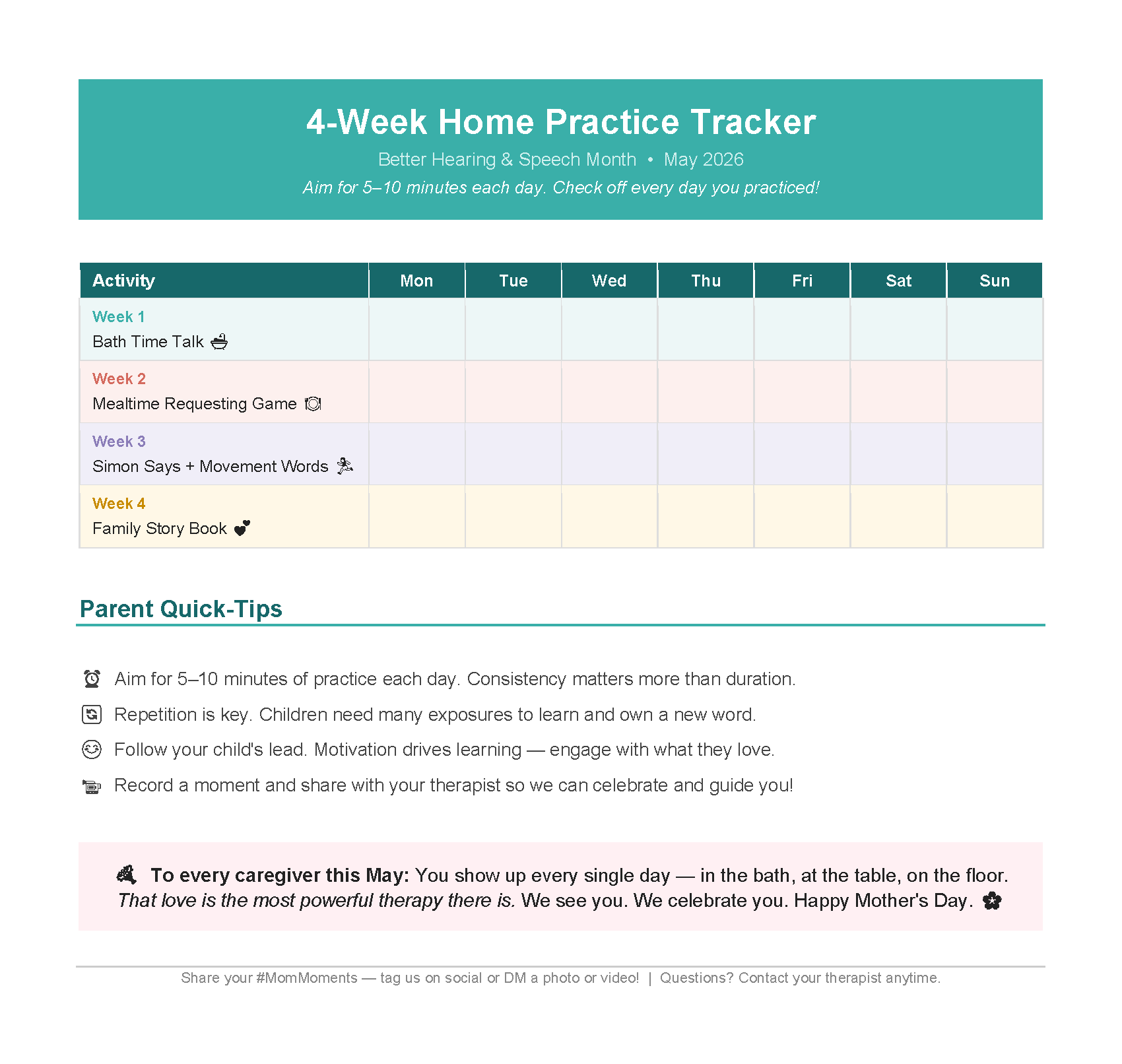
Track Your Progress All Month

Consistency is the key to progress. Download our free 4-Week Home Practice Tracker and check off each day you practiced. It’s a simple way to stay motivated and see how much you’re doing!
pediatric therapy resources

Our pediatric therapy team is committed to supporting every family that we work with. Our services are designed to maximize your child's potential and success. Check out our Resources Page for information and free downloads designed to help elevate your child's therapy. Feel free to CONTACT US today!

Resources Get Started

Therapy Works Blog

pediatric therapy atlanta
By WBT Therapy-Works April 7, 2026
We focus on empowering every child through connection & function with our pediatric therapy services. It’s National Autism Awareness Month & Occupational Therapy Month.
pediatric therapy
By WBT Therapy-Works March 17, 2026
Want to Target Developmental Skills with your child to assist with your pediatric therapy? Check out these helpful tips and resources.
therapy works blog
By WBT Therapy-Works February 17, 2026
Our blog is our digital headquarters for our pediatric speech, occupational, and physical therapy services in Metro Atlanta & Georgia. Get advice, trends and more.
By Brooke Terrell April 24, 2025
Celebrating OT Month: Meet Our Incredible Occupational Therapists at Therapy Works
By Kassidy Birmingham OTR/L February 27, 2025
March Into Success: Building Healthy Habits with Virtual Therapy
By Kassidy Birmingham MOTR/L December 12, 2024
Holiday Routines: Setting Kids Up for Success This Season
By Kassidy Birmingham MOTR/L December 10, 2024
Fun and Festive Holiday Activities to Support Your Child’s Development
By Kassidy Birmingham MOTR/L December 4, 2024
How Can Teletherapy Help My Child?
By Kassidy Birmingham MOTR/L December 3, 2024
With the holiday season upon us, choosing toys that entertain and nurture your child's growth can make each gift even more special. Here’s a guide to help you select toys that support occupational, physical, and speech therapy skills—along with tips on the benefits of open-ended toys that encourage creativity and imaginative play. Why Open-Ended Toys? Open-ended toys are designed to spark imagination and creativity. Unlike toys with a single function, open-ended toys offer endless ways to play, allowing children to use their imagination to explore, create, and problem-solve in their own unique ways. Benefits of Open-Ended Play: Encourages cognitive development, social skills, and flexible thinking by allowing children to come up with their own play scenarios and solutions. Examples: Blocks, dollhouses, magnetic tiles, and even simple items like scarves or cardboard boxes can transform into anything a child imagines—from castles to spaceships—promoting creativity and exploration. Toys That Enhance Fine Motor Skills Fine motor skills are essential for tasks like writing, buttoning, and using utensils. Toys that build hand strength and coordination are especially helpful. Play-Doh or Modeling Clay: Strengthens hands, enhances creativity, and builds coordination. Bead Kits and Stringing Activities: Improve the pincer grasp and bilateral coordination. Construction Sets (like LEGO or Magna-Tiles): Great for precision, grip strength, and spatial skills, all while fostering open-ended creativity. Gross Motor Skill-Boosting Toys Toys that promote movement and physical activity help with balance, coordination, and overall body strength. Balance Boards or Wobble Boards: Encourage core strength, balance, and stability in a fun, challenging way. Scooters and Tricycles: Boost leg strength, coordination, and confidence in body movement. Soft Play Equipment: Foam climbing blocks or tunnels offer safe ways to climb, crawl, and explore. Speech and Language Development Toys Toys that encourage communication and interaction help children develop essential language skills. Pretend Play Sets (like a kitchen or doctor’s kit): Expand vocabulary, storytelling, and social interaction in an open-ended format. Interactive Books and Story Cards: Improve listening, attention, and expressive language. Board Games (like Guess Who? or Charades for Kids): Practice turn-taking, following instructions, and building conversational skills. Sensory-Engaging Toys Toys with tactile, auditory, or visual feedback can support sensory processing and are great for children who benefit from calming sensory input. Sensory Bins or Kinetic Sand: Perfect for tactile exploration, building sensory tolerance, and calming play. Musical Instruments (like tambourines or maracas): Enhance auditory processing, rhythm, and coordination. Weighted Stuffed Animals or Blankets: Provide calming, deep-pressure input, ideal for children who benefit from sensory regulation. Cognitive and Executive Functioning Toys Toys that challenge problem-solving, planning, and memory skills are ideal for cognitive and executive functioning development. Puzzles and Memory Games: Build problem-solving skills, working memory, and focus. STEM Kits (like coding robots or science kits): Foster critical thinking, sequencing, and curiosity. Matching and Sorting Games: Help with categorization, math skills, and attention to detail. Tips for Choosing the Right Toy Look for Open-Ended Options: Toys that can be used in various ways encourage your child to take charge of play and explore their creativity. Choose Montessori-Inspired Toys: Simple, natural, and purposeful toys give children hands-on learning opportunities at their own pace. Age Appropriateness: Select toys suitable for your child’s age and developmental level. Durability: Choose high-quality toys that can endure active play and exploration. Wrap-Up Picking toys that support OT, PT, and ST goals adds value to holiday gift-giving, and the right toy can bring both joy and developmental support. From open-ended and Montessori-inspired options to skill-building games, choosing thoughtfully can help make playtime meaningful and engaging for your child’s growth.
By Brooke Terrell November 12, 2024
Subscribe to our Newsletter to see all monthly updates & Activities